Chino Basin Water Rights - An Empirical Overview
Introduction
Understanding water market dynamics requires detailed data on both historical transactions and water rights allocations. However, such data are largely nonexistent. This work focuses on the Chino Basin, California, and represents the first systematic effort to collect, process, and represent these critical inputs, providing a structured basis for analyzing trading behavior and market outcomes, supporting the novel stochastic game-theoretic model of groundwater rights trading among rational agents introduced in (Cialenco & Ludkovski, 2025).
Basin Background
The Chino Basin is located in San Bernardino County, approximately 35-45 miles east of Los Angeles. It encompasses approximately 220 square miles. This basin was adjudicated in 1978 by the San Bernardino County Superior Court and established the Chino Basin Watermaster.
The basin has a three-pool structure, where
-
Pool 1 - Overlying (Agricultural): farmers, agricultural producers, and the State of California. These rights are not tradeable.
-
Pool 2 - Overlying (Non-Agricultural): industrial and commercial water users. These rights are tradeable.
-
Pool 3 - Appropriative: cities, special districts, and utilities that pump groundwater for public water supply purposes. These rights are also tradeable.
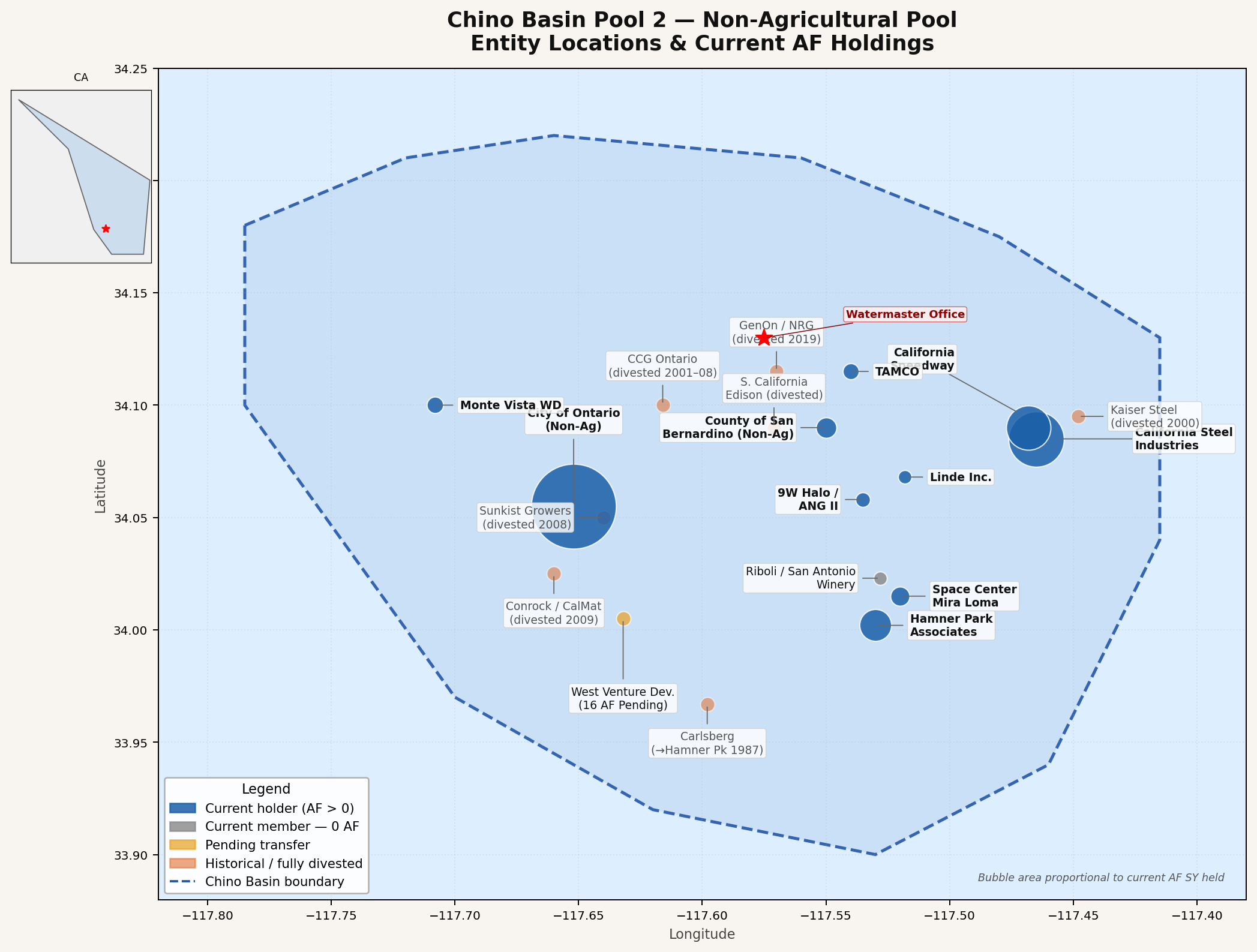
In the original 1978 Judgment, there is a distinction between the original allocation and the Safe Yield (SY). Safe yield is the amount the basin can sustainably produce annually in perpetuity, the renewable, long-term yield of the aquifer. This is important, because the safe yield is what the entities actually trade. Total Allocated AF (acre-feet) is larger, because it also includes a share of the controlled overdraft, a finite one-time drawdown of groundwater storage that the court allowed parties to pump beyond safe yield.
The Data
The transaction data from both pools was obtained from records maintained by the Chino Basin Watermaster. These documents record every permanent transfer made since the 1978 Judgement. The raw transaction data was then structured into Excel workbooks, one per pool, each organized into a Transactions sheet, an Entity Reference sheet, and a Dataset Notes sheet.
All water transactions are measured in acre-feet (AF) - the volume of water needed to cover one acre of land to a depth of one foot, equivalent to approximately 326,000 gallons. Since Pool 1 (Agricultural) does not have tradeable water rights, no transaction information exists for this pool, and the analysis focuses on Pools 2 and 3. Pool 2 (Non-Agricultural) has a total Safe Yield of 7,366 AF. Transactions between entities exist for both Pool 2 and Pool 3. A total Safe Yield figure for Pool 3 is not available in the primary sources.
Transactions are structured in three categories: permanent, tenants in common, and jointly held. A permanent transfer is an outright transfer of water rights from one entity to another. Tenants in common is a co-ownership of a water rights block by two parties with a negotiated priority structure. Jointly held with agreed priorities is slightly different than tenants in common in that the priority structure was explicitly negotiated. The Kaiser/CSI 630.274 AF arrangement in the Pool 2 transactions is described as jointly held. Transactions in both Pools 2 and 3 have either precise decimals or round numbers. Round numbers in transactions come from negotiated transfers, and precise decimals trace back to the 1978 Judgement allocations.
Market Observations
Pool 2 is an infrequently traded market with 25 transactions between 19 entities, spanning over 40 years.
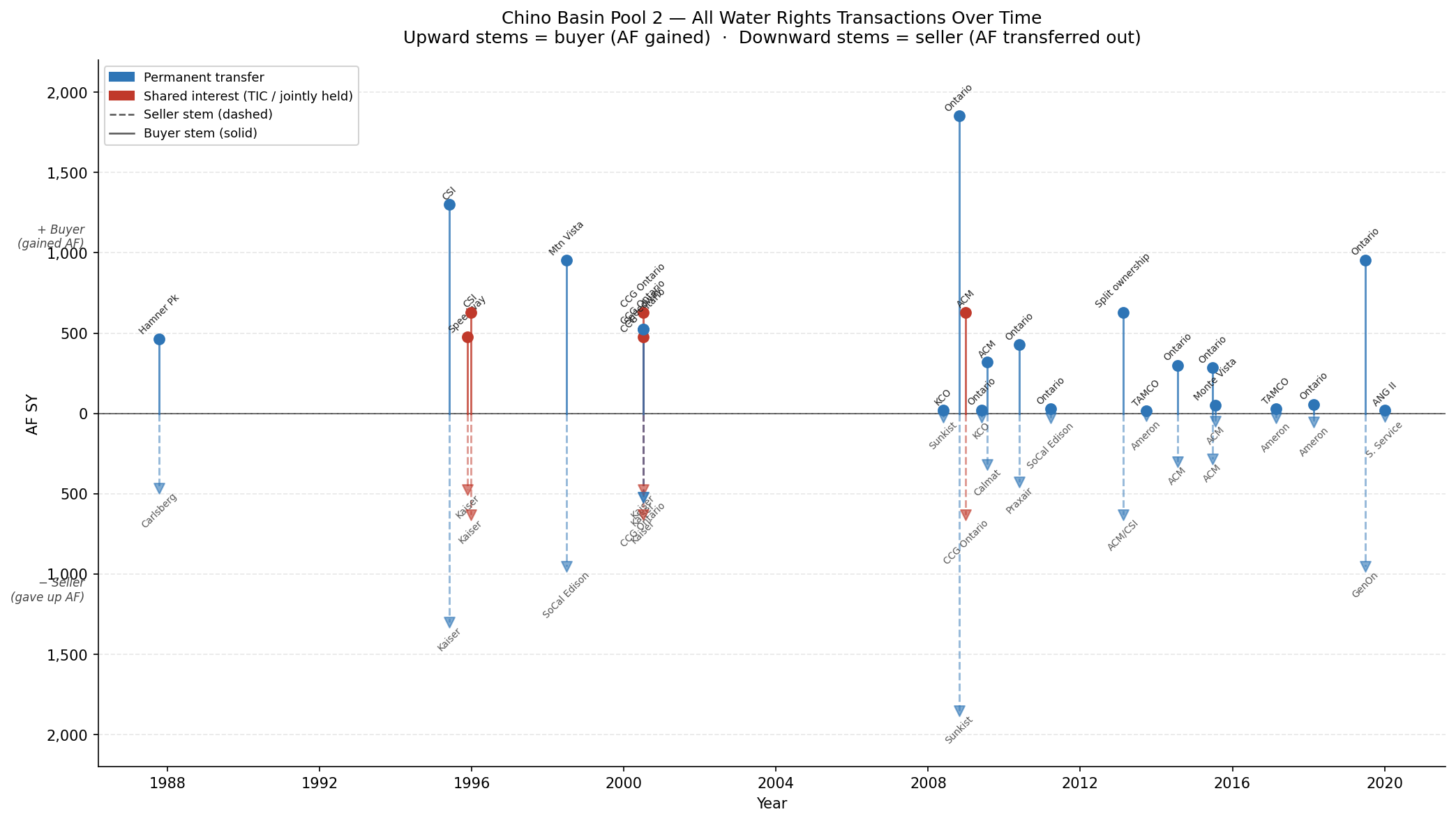
- Kaiser Steel was a dominant original holder, but later divested all their rights.
- City of Ontario was the biggest accumulator, accumulating 3,920.567 AF SY of water rights over time.
- This is over 53% of the entire Pool 2 Safe Yield, acquired through six separate acquisitions between 2008 and 2018.
- Pool 2 trading is heavily clustered during these two periods 1995-2000, Kaiser’s divestiture and 2008-2018, Ontario’s accumulation.
- ACM (Aqua Capital Management) acquired rights from CCG Ontario and Calmat in 2008-2009 and then sold them off entirely by 2015.
- This behavior is unlike any other entity in the Pool 2.
Fig 3: Pool 2 - Water Rights Allocations Over Time
Pool 3 is also infrequently traded due to the nature of the Appropriative pool, where rights are primarily held by public water agencies. Pool 3 had 12 transactions since 1978.
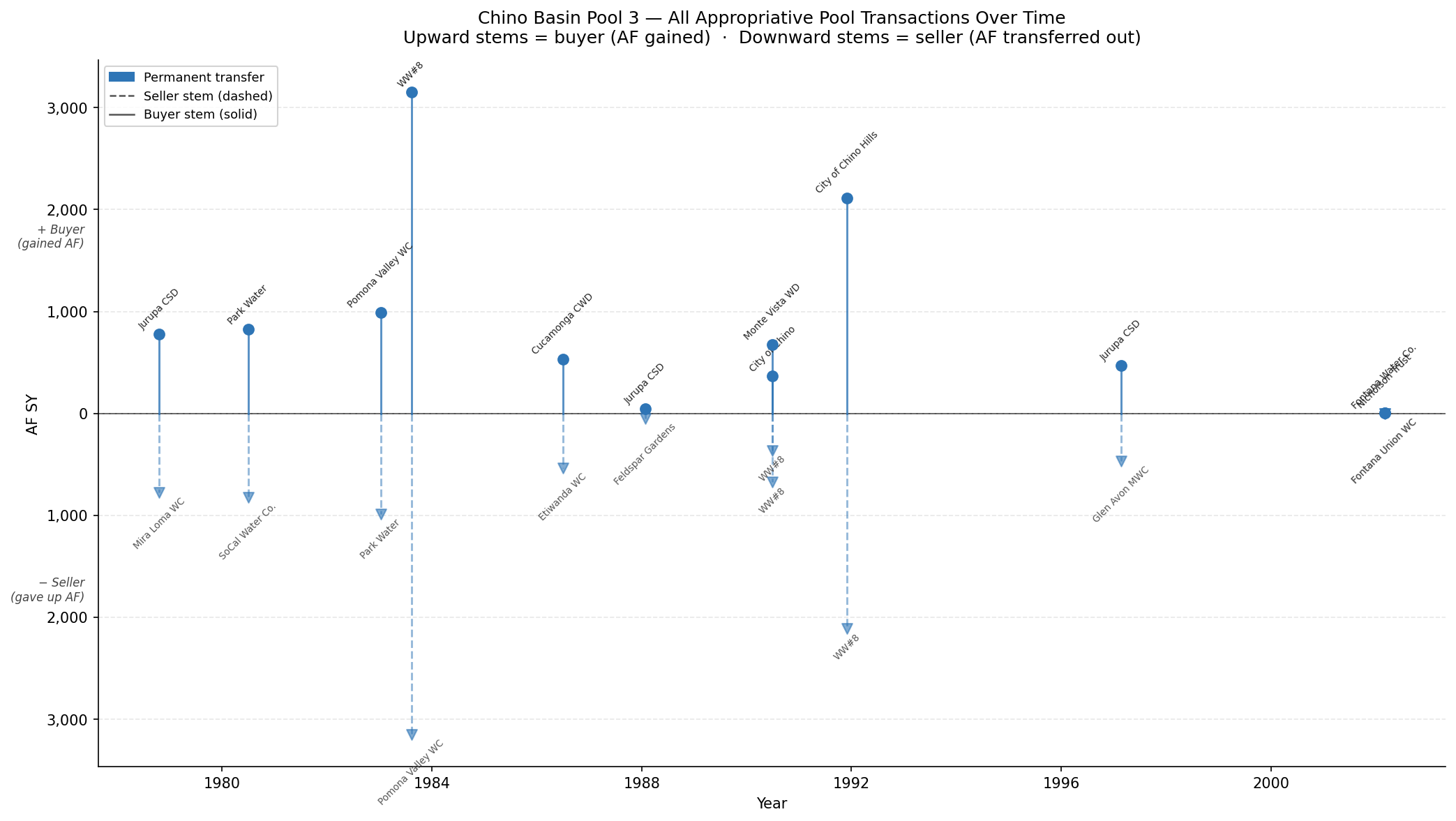
- Pool 3 activity is concentrated entirely in 1978-2002, driven by the consolidation of smaller water companies into larger public agencies.
- Many entities in the Appropriative pool retained their entire share of the water rights, not making any trades.
- Unlike Pool 2, Pool 3 has no tenants in common or jointly held agreements, only permanent transfers.
Fig 5: Pool 3 - Water Rights Allocations Over Time
Limitations
With all of the information that we have regarding the Chino Basin, there are still significant limitations.
- The biggest of these is that there is no transaction pricing data for any of the permanent Pool 2 or Pool 3 rights transfers. Without this, it isn’t possible to characterize the price at which rights have historically traded, which is a crucial input for calibrating the model.
- In addition to this, we don’t have access to older annual reports, which would provide additional insight into historical transactions.
- The available documents do not cover Pool 1 (Agricultural), as the rights are a shared pool and not individually tradeable
- There is a lack of information when it comes to water rights usage for entities that are holding tenants in common with each other. It is not clear what percentage of the water rights each entity is allowed to utilize according to their agreements.
- Some of the historical transactions only contain years and not specific dates, which introduces uncertainty in the timeline of transactions.
- Lastly, some Pool 3 entities made no transfers of their original rights and therefore do not appear in the transaction data.
References
Enjoy Reading This Article?
Here are some more articles you might like to read next: