Pro-rata Distribution for Groundwater Market
Following the stochastic game framework for groundwater markets in (Cialenco & Ludkovski, 2025), we consider $j=1,\ldots,J$ farmers who produce goods. Each farmer $j$ has $W_j$ acre-feet (a.f.) of water that can either be used for production—generating profit $G_j(C)$ by using $C$ a.f.—or traded $\psi_j$ with other farmers, where $\psi_j > 0$ means selling and $\psi_j < 0$ means buying.
For a fixed price $p > 0$, each farmer solves:
\[\max_{C_j,\psi_j} \; G_j(C_j) + p\psi_j\]subject to:
\[\underline{c}_j \leq C_j \leq \bar{c}_j, \quad \sum_i \psi_i = 0.\]The bounds $\underline{c}_j \leq C_j \leq \bar{c}_j$ represent production constraints, and $\sum_i \psi_i = 0$ is the market clearing condition. We assume $G_j$ is concave and define:
\[L_j(C_j, \psi_j, p) = G_j(C_j) + p\psi_j.\]The farmers play a non-cooperative Nash game, and as shown in (Cialenco & Ludkovski, 2025):
- Every price $p > 0$ is a Nash equilibrium (NE).
- There exists a unique price $p^*$ corresponding to a Pareto optimal strategy.
-
A strategy \((\pi^{*}, p^{*})\) is Pareto optimal if there is no \((\pi', p')\) such that:
\[\forall j,\; L_j(\pi', p') \geq L_j(\pi^*, p^*), \quad \text{and } \exists i:\; L_i(\pi', p') > L_i(\pi^*, p^*)\] - At $p^*$, agents trade the maximum amount of water and demand equals supply.
- For $p \neq p^*$, demand differs from supply, leading to market imbalance.
To handle imbalance when $p \neq p^*$, we introduce a pro-rata mechanism.
Pro-rata Mechanism
Fix a price $p$ and allocation $W_j$. Each farmer chooses optimal consumption:
\[C_j^\circ = \arg\max_{C_j} \left[ G_j(C_j) + (W_j - C_j)p \right]\]subject to: \(\underline{c}_j \leq C_j \leq \bar{c}_j.\)
Define: \(\underline{p}_j = \max \{ p : C_j^\circ(p) = \bar{c}_j \}, \quad \bar{p}_j = \min \{ p : C_j^\circ(p) = \underline{c}_j \}.\)
At price $p$, farmer $j$ is willing to trade: \(W_j - C_j^\circ(p).\)
Trading occurs when: \(\underline{p} := \min_j \underline{p}_j \leq p \leq \bar{p} := \max_j \bar{p}_j.\)
Main Idea: Under pro-rata, excess demand (or supply) is distributed proportionally among buyers (or sellers).
Let sellers $\mathcal{S}$ and buyers $\mathcal{B}$ be defined, and:
\[\mathbf{S} = \sum_{j \in \mathcal{S}} (W_j - C_j^\circ), \quad \mathbf{B} = \sum_{j \in \mathcal{B}} (W_j - C_j^\circ).\]Case 1: Supply < Demand ($\mathbf{S} < \mathbf{B}$)
Each buyer $j \in \mathcal{B}$ consumes:
\[\widetilde{C}_j = W_j + \frac{C_j^\circ - W_j}{\mathbf{B}} \cdot \mathbf{S}.\]Case 2: Supply > Demand ($\mathbf{S} > \mathbf{B}$)
Each seller $j \in \mathcal{S}$ consumes:
\[\widetilde{C}_j = \left( C_j^\circ + \frac{W_j - C_j^\circ}{\mathbf{S}} (\mathbf{S} - \mathbf{B}) \right) \wedge \bar{c}_j.\]The pro-rata mechanism ensures fairness, predictability, and transparency, and every price remains a Nash equilibrium.
We consider a market with four participants. The realized consumption $\widetilde{C}_j$ (solid lines) and optimal desired consumption $C_j^\circ$ (dashed lines) are shown in Figure 1.
- For $p \le \underline{p} = 0.063$: all farmers want to buy → no trade occurs.
- For $\underline{p} \le p \le \bar{p}$: both buyers and sellers exist.
- At $p^* = 0.13$: demand equals supply → Pareto optimal outcome.
- For $p > p^*$: supply exceeds demand → sellers consume more than optimal.
- For $p > \bar{p}$: all farmers prefer selling → no trade again.
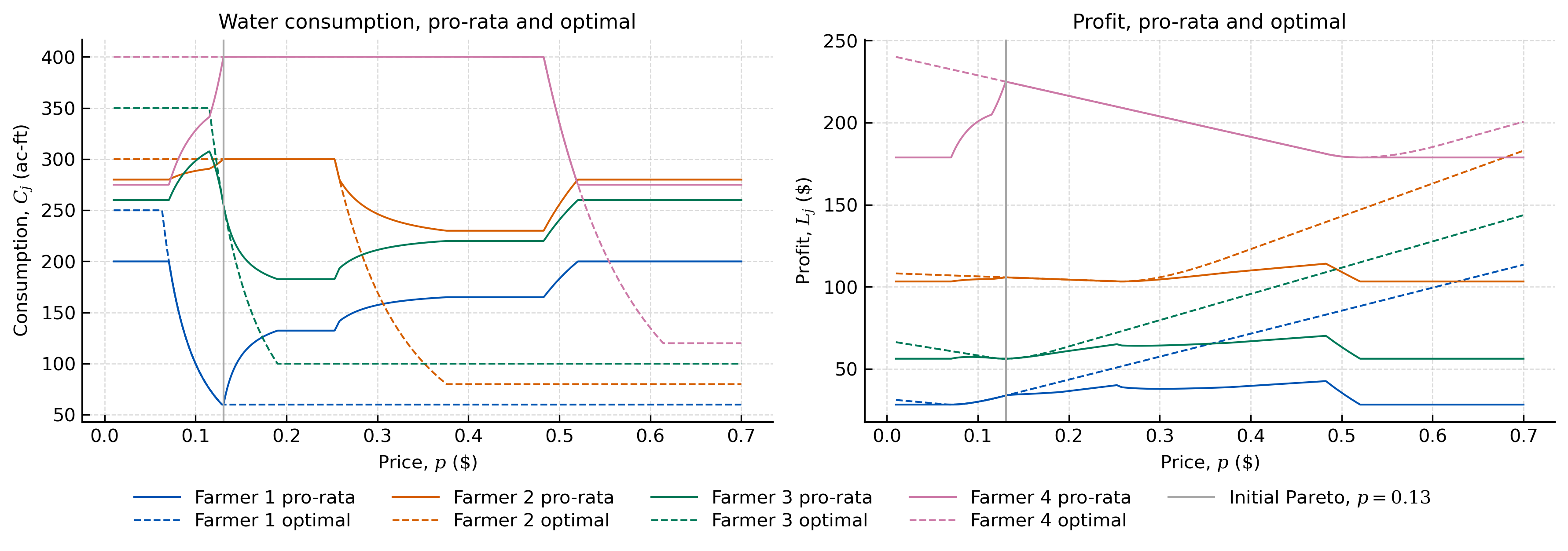
Overall: under pro-rata allocation, consumption is not necessarily monotone in $p$, and profits exhibit more complex behavior than individually optimal outcomes.
Enjoy Reading This Article?
Here are some more articles you might like to read next: